How Nonprofits and Churches Can Use AI in 2026 Without Losing What Makes Them Human

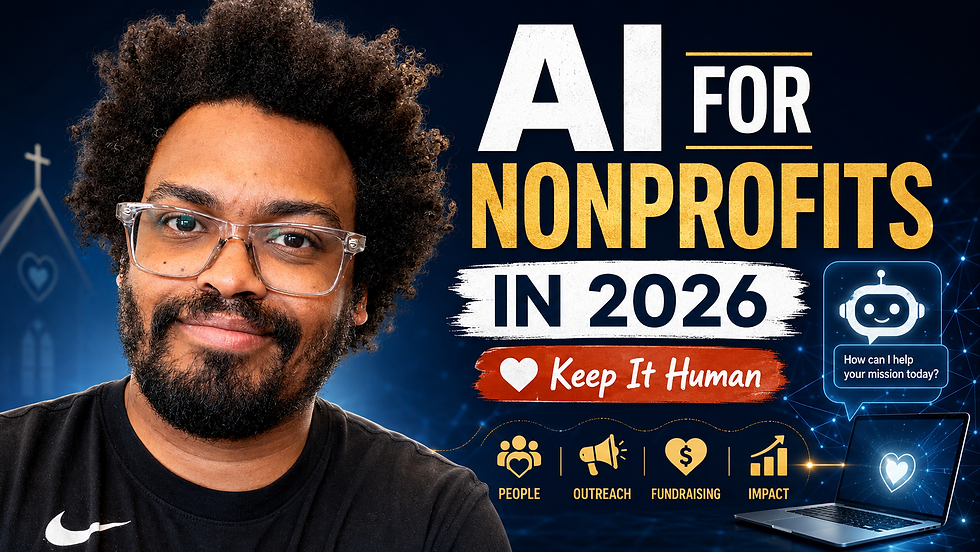
Artificial intelligence is no longer a buzzword for tech companies. In 2026, it is a tool that every faith-based nonprofit and church needs to understand, even if they choose not to use all of it. In a recent episode of the Nonprofit Missionary Podcast, host Ken McQuiller shared his firsthand experience using AI in his grant writing consulting practice and the lessons he has learned along the way.
Whether you are a skeptic or a curious early adopter, this guide breaks down the key takeaways from that conversation.
AI Is Evolving Faster Than Most Realize
Ken opened with a simple but striking illustration: the Will Smith eating spaghetti AI video. In 2023, it looked obviously fake and janky. By 2025 and 2026, similar AI-generated videos look nearly realistic. The technology has changed dramatically in just a few years, and that pace is only accelerating.
For nonprofits, the takeaway is this: you do not have to use AI for everything, but you do need to be aware of where it is heading and how it can help or hurt your mission.
Practical Ways AI Can Help Your Nonprofit Right Now
1. Grant Writing Assistance
Ken offers a custom GPT tool called Grant Writing OS, built specifically for faith-based nonprofits. Rather than using a generic AI tool, a custom GPT is trained on your organization's specific information, voice, and funding needs. It helps write grant proposals that are accurate and on-brand, reducing the risk of AI hallucinations or inaccurate claims.
Key takeaway: A custom AI grant writing tool can speed up your process significantly, but it still requires human review before submission.
2. Administrative Task Automation
One of the biggest time-savers AI offers is automating repetitive administrative work. Ken highlighted several examples:
Automating donor thank-you emails using tools like Airtable combined with AI
Generating social media captions based on video content
Reformatting documents and surveys for better visual presentation
His Stewardship OS tool, for example, connects with donor data and generates personalized thank-you drafts that a staff member simply reviews and approves before sending.
Ask yourself: What is the one task at work that eats the most time and could be templated? That is where to start with AI automation.
3. Content Creation Support
Using AI to draft blog posts, short-form video scripts, and email newsletters has saved Ken significant time. He noted that platforms like Descript (which he uses for video editing) also have AI built in to help streamline content production.
The key is to use AI as a starting point, not a final product.
The Biggest Mistake Nonprofits Make with AI: Over-Planning
Ken was candid about a trap he has fallen into himself. When building AI tools and systems, it is easy to get stuck in endless planning, trying to make everything perfect before launching. The result is that nothing ever gets published or implemented.
His advice: Start imperfect and adjust as you go. Your AI tool will fail at first. That is normal. The people who succeed with AI are the ones who deploy early and iterate, not the ones who wait until everything is flawless.
This principle mirrors what author John Acuff writes in "Procrastination Proof," which Ken referenced in the episode. The "planner" personality type procrastinates by over-preparing rather than doing. If that sounds familiar, it might be time to just hit publish.
The ChatGPT Bias Problem
Here is something most people overlook: ChatGPT is designed to affirm you. It will tell you your ideas are great, your strategy is solid, and your plan will work, even when it will not. This built-in positivity bias can be genuinely dangerous, especially when people use AI as a counselor, therapist, or primary source of advice.
Ken referenced two real-world examples:
A young man who became emotionally dependent on ChatGPT and tragically ended his life
A man who suffered a mental breakdown after ChatGPT convinced him that algorithms were secretly saving the world, only for him to discover through a different AI that none of it was real
The lesson: Use AI for tasks, not for truth. Always bring in human review and external perspective, especially when making major decisions.
Every Nonprofit Needs an AI Usage Policy
If your organization is starting to use AI, you need a written policy. This does not have to be complicated, but it should address:
What content must be reviewed before it is sent or published
Who has authority to approve AI-generated materials
Whether your organization discloses when content was created with AI assistance
Having this policy in place protects your organization, your donors, and your community. It also ensures that AI serves your mission rather than replacing your judgment.
AI Is Not Stealing Jobs. It Is Changing Them.
A common fear is that AI will eliminate jobs at nonprofits and churches. Ken pushed back on that narrative. Just as farming gave way to industrial work and office jobs replaced manual labor over generations, AI is shifting what roles look like, not erasing them.
Your administrative assistant is not going to be replaced. They are going to spend less time on repetitive tasks and more time on higher-value work. That is a shift worth embracing, not fearing.
Live Events Are the Future, Not the Past
This was perhaps the most surprising insight from the episode. In a world where AI can generate realistic content at scale, live in-person events become more valuable, not less.
Ken cited a podcast he had heard recently that made this point clearly: live events are AI-proof. You cannot fake a room full of real people experiencing something together. As trust in digital content erodes and isolation increases, people will hunger for authentic community.
For nonprofits and churches, this means:
Invest in live fundraising events that center on connection
Prioritize in-person gatherings where possible
If you have an online presence, supplement it with real-world touchpoints
This is especially relevant for churches navigating the balance between digital outreach and physical community.
Key Takeaways
AI is evolving fast. Nonprofits need to be aware even if they are not early adopters.
Start with automation. Identify your most repetitive tasks and see if AI can handle the first draft.
Stop over-planning. Build something imperfect and improve it as you go.
Never skip human review. AI needs your judgment before anything goes out the door.
Create an AI usage policy. Protect your organization with clear guidelines.
Live events are more valuable than ever. Do not abandon in-person community in favor of digital convenience.
Ready to Explore AI for Your Nonprofit?
Ken McQuiller offers grant writing support and custom AI tools built specifically for faith-based nonprofits. If you want to learn more about Grant Writing OS, Stewardship OS, or nonprofit consulting services, reach out at nonprofitmissionary@gmail.com or visit nonprofitmissionary.com.
Follow the Nonprofit Missionary Podcast on Facebook, Instagram, and TikTok at @NonprofitMissionary.
Stay focused. Stay funded. God bless.


Comments